
The Risks of DIY Paintless Dent Repair: Why Professional PDR Wins
So, you found a dent. Maybe it was a stray shopping cart at the grocery store or a mysterious “gift” left by a car door in a parking garage. Your first instinct might be to pull up a video online and see if you can handle it yourself. The allure of the DIY method is strong, especially when you see people using plungers, boiling water, or cheap kits from the internet.
At American Dent Specialists, we get asked about the DIY approach all the time. Our answer is usually delivered with a bit of a smile. One of the reasons we have both a paintless dent repair shop and a full collision center at Collision Craftsman is that if you try to fix it yourself and things go sideways, we are perfectly equipped to rescue the project using conventional repair methods. While we enjoy a good laugh, the reality is that DIY dent repair often turns a simple fix into an expensive disaster.
What is Paintless Dent Repair?
Before we get into the dont’s, let’s talk about right approach…
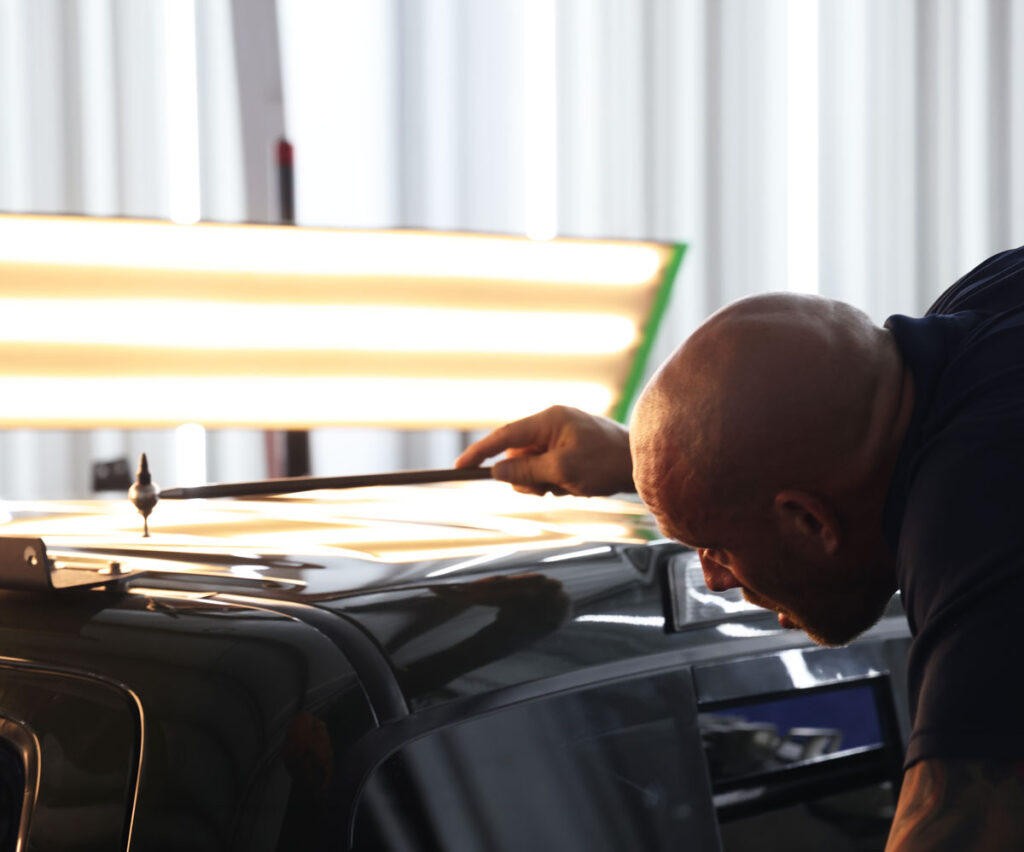
Paintless Dent Repair, or PDR, is a specialized process of removing dents from the body of a vehicle without disturbing the original factory finish. It is a highly surgical process. Technicians use custom-designed tools to gain access behind the damaged panel and meticulously “massage” the metal back to its original shape.
Because the factory paint remains intact, PDR is the preferred method for maintaining a vehicle’s resale value. There is no sanding, no body filler, and no mismatched paint. However, because it relies on the elasticity of the metal and the bond of the paint, there is zero room for error.
5 Signs Your Dent is a Candidate for PDR:
- The paint is not cracked or peeling.
- The dent is not located near the very edge of a panel.
- The vehicle is a 1990 model or newer (better paint flexibility).
- The dent was caused by a soft object or a low-speed impact.
- You haven’t tried to fix it yourself yet!
Now that you know Paintless Dent Repair is an option, you should know that it is NOT a DIY kind of repair, despite some myths you might find on YouTube and TikTok.
Common DIY Dent Repair Myths
The internet is full of “quick fixes” that promise professional results for pennies. Let’s look at why these usually fail. The below are some methods out there that you may be tempted to try to save a buck… DON’T TRY THEM! You’ll end up with a worse problem than when you started:
The Hot Water and Plunger Method
The theory here is that heat makes the metal pliable and the suction pulls the dent out. While this might work on a very large, shallow dent on a plastic bumper, it is almost entirely useless on metal panels. Modern automotive steel and aluminum have “memory.” A plunger lacks the precision to address the specific pressure points holding a dent in place.
Over-the-Counter Suction Kits
The kits you find at big-box stores often use low-grade glue and plastic tabs. If the glue is too weak, it does nothing. If it is too strong, or if your paint has a microscopic chip you didn’t notice, you risk pulling the paint right off the metal. Now, instead of a simple PDR job, you are looking at a full repaint.
The Dry Ice or Compressed Air “Thermal Shock” Method
One of the more creative (and dangerous) myths involves using extreme temperature changes to pop a dent back into place. The theory is that by heating the metal with a hairdryer and then quickly cooling it with dry ice or a can of compressed air held upside down, the rapid contraction will force the metal to snap back to its original shape.
In reality, this rarely works on modern automotive grade steel. While you might get a “pop” sound, the metal often fails to return to a perfectly flat state. More importantly, the extreme thermal shock can cause the clear coat to become brittle and shatter. If you cause the paint to crack or flake through thermal stress, you have turned a simple paintless repair into a much more expensive project at our parent shop, Collision Craftsman.
The Hot Glue and Wooden Dowel Pulling Method
Inspired by professional glue pulling systems, some DIYers attempt to glue wooden dowels or specialized tabs to the center of a dent and pull it out by hand or with a makeshift slide hammer. The logic is sound, but the execution is often flawed because of the materials used.
Professional technicians use specific grades of glue that are designed to release from the paint without taking the clear coat with them. Household hot glue or industrial adhesives can bond too strongly to the surface. When you pull, you risk “lifting” the paint entirely. Additionally, a professional knows exactly where to place a tab to relieve the tension of a door ding or hail damage. A DIYer usually pulls from the center of the dent, which can create a “volcano” effect where the metal is pulled too far outward, creating a high spot that is nearly impossible to flatten without professional tools.
Why PDR Requires Professional Training
Paintless dent repair is an art form that takes years to master. At American Dent Specialists, we have been doing this at an expert level for 25 years. We consider ourselves the tip of the spear in the Houston area because we understand the physics involved.
Tool Precision and Access Points
A professional PDR kit contains dozens of rods, wires, and specialized “whale tails” designed to reach into the tiny crevices of a vehicle’s frame. Knowing exactly where to place a tool behind a fender or inside a door skin without damaging internal electronics or window regulators is something that only comes with experience.
Understanding Metal Memory and Paint Integrity
Metal isn’t just a flat surface. It has grain and tension. When a dent occurs, the metal is stretched. A professional knows how to “shrink” that tension back into place. A DIYer usually ends up “over-pushing,” creating high spots that look like pimples on the car’s surface. These are much harder to fix than the original dent.
The Financial Risk of a “DIY-Don’t”
The goal of DIY is to save money, but the logic is often flawed. A standard PDR repair is relatively affordable and fast. If a DIY attempt stretches the metal too far or cracks the paint, PDR is no longer an option.
Once the paint is cracked or the metal is “oil-canned” (meaning it has lost its structural tension), the car must go to a collision center. This involves grinding down to the bare metal, using body filler, priming, and painting. What could have been a same-day PDR fix becomes a multi-day conventional repair that costs significantly more and shows up on a vehicle history report.
The “Deep Context”: The Physics of Stretched Metal
To understand why we push back on DIY, you have to understand the “elastic limit” of automotive metal. When a dent happens, the metal molecules are displaced. Professional PDR technicians work within the “elastic” range of the metal, nudging it back without changing its molecular structure.
A DIY attempt, particularly one involving excessive force or incorrect heat, often pushes the metal into the “plastic” range. This is the point of no return where the metal is permanently thinned or stretched. Once the metal is stretched, it becomes floppy. No amount of massaging will make it flat again. At that stage, the only fix is traditional bodywork at a shop like Collision Craftsman.
|
Repair Method |
Time Investment |
Paint Integrity |
Cost Risk |
|---|---|---|---|
|
Professional PDR |
✅ Hours |
✅ 100% Preserved |
✅ Low/Fixed |
|
DIY Attempt |
🤬 Days of Frustration |
❌ High Risk of Cracking |
💸💸 Very High |
|
Conventional Repair |
⚠️ Days / Weeks |
🔄 Repainted |
🫰 High |
Serving the Houston Community for 25 Years
We aren’t just technicians; we are your neighbors. Based in the heart of Houston, we serve the Energy Corridor, Spring Branch, and the greater metro area. We have spent two decades refining our craft so that you don’t have to experiment on your own vehicle.
The Houston climate actually plays a role in how we work. High heat can make automotive paint more flexible, which is sometimes an advantage during a complex body line repair. We understand these local variables and use them to ensure your car stays in its original factory condition whenever possible.
Frequently Asked Questions About Body Line Dent Removal
Experience the American Dent Specialists Difference
Deciding on the right repair for your vehicle shouldn’t feel like a gamble. Whether you are dealing with a sharp crease on a body line or a soft dent on a hood, you deserve a partner who values your car as much as you do. Our team at American Dent Specialists is here to provide the technical expertise and the honest communication that Houston drivers have relied on for over two decades. If we can fix it to perfection, we will show you how. If PDR isn’t the right path, we will be the first to tell you. Reach out to us today for a transparent assessment and let us help you get your vehicle back to its best condition.
📍 Visit the shop: 1729 Brittmoore Road, Unit G, Houston, TX 77043
📞 Call us: (281) 660-3178
📅 Schedule: americandentspecialists.com
Need a Paintless Dent Repair Quote?
Just send us pictures of your damage and we’ll get you a personalized quick estimate!