
Here’s The Facts About Hail Size and Car Damage
One inch. That’s the short answer, and it’s the number we’ve worked to for twenty-five years of Houston hail seasons.
Hail about an inch across — roughly the size of a quarter — carries enough mass to dent steel and aluminum panels on its own, without any help from the wind. Below that, most cars come through fine. Above it, the odds turn quickly.
That’s the rule of thumb. The rest of this page covers what it actually looks like at each size, why wind changes the maths, and what to do if you’ve just watched it happen to your car.
Hail Size and What It Does to a Car
|
Hail Size |
Everyday Comparison |
What it typically does |
|---|---|---|
|
¼ inch |
Pea |
Rarely any damage unless wind-driven |
|
½ inch |
Marble |
Minor marks possible on softer panels |
|
¾ inch |
Penny |
Usually little damage; possible on thin panels |
|
1 inch |
Quarter |
Damage starts here — dents on hood, roof and trunk |
|
1¼ inch |
Half dollar |
Widespread denting; a claim is usually worth filing |
|
1¾ inch |
Golf Ball |
Deep dents including side panels; glass at risk |
|
2½ inch |
Tennis Ball |
Severe — cracked paint, broken glass |
|
4 inch+ |
Soft Ball |
Catastrophic; possible total loss |
When it comes to hail damage on a vehicle, the horizontal surfaces take the worst of it. Hood, roof and trunk lid catch hail falling straight down, which is why those three panels dominate almost every claim we write. Doors and quarter panels usually only get involved once wind enters the picture.
How Big Does Hail Have to Be to Dent a Car?
It’s less about size on its own and more about how much energy the stone is carrying when it lands.
A one-inch hailstone falling from thunderstorm height is arriving hard. Sheet metal is thin, unsupported across the middle of a panel, and it gives. That’s the threshold where gravity alone is enough.
Three things move that line:
Panel thickness. Modern cars use thinner steel and more aluminum than they did twenty years ago. It’s part of why we see damage now from storms that would have left a 1990s car alone.
Where the stone lands. The middle of a large flat panel has the least support behind it. Edges, body lines and reinforced areas resist far better.
Whether the car was moving. A car doing 60 into falling hail is a very different impact from the same car parked. We see noticeably worse damage on vehicles caught on the freeway than on ones sitting in a driveway through the same storm.
Why Wind Changes Everything
Straight-down hail hits your horizontal surfaces. Wind-driven hail hits everything.
When a storm has serious wind behind it, half-inch hail can do what one-inch hail does on a calm day — and it starts hitting doors, quarter panels, mirrors and side glass, none of which take a direct hit otherwise.
That’s why two people in the same neighbourhood can come out of the same storm with completely different results. One car was in a garage. One was facing into the wind on an open street. The stones were identical.
So if the hail looked small but your car has dents anyway, you’re not imagining it, and it’s still a valid claim.
What to Do If You’re Caught in a Hailstorm
Stay in your car.
If you’re driving when it starts, pull over somewhere safe and wait it out. Don’t get out to look, and don’t try to cover the car. Anything big enough to dent a hood is big enough to open your scalp, and there is no version of this where the paint matters more than you do.
If you can get under a covered structure — a gas station canopy, a parking garage, an overpass — take it, provided you can do it without stopping in a live traffic lane.
Once it’s passed:
- Photograph everything before you move the car, and get the hailstones next to a coin or tape measure if any are still on the ground. Size evidence helps a claim.
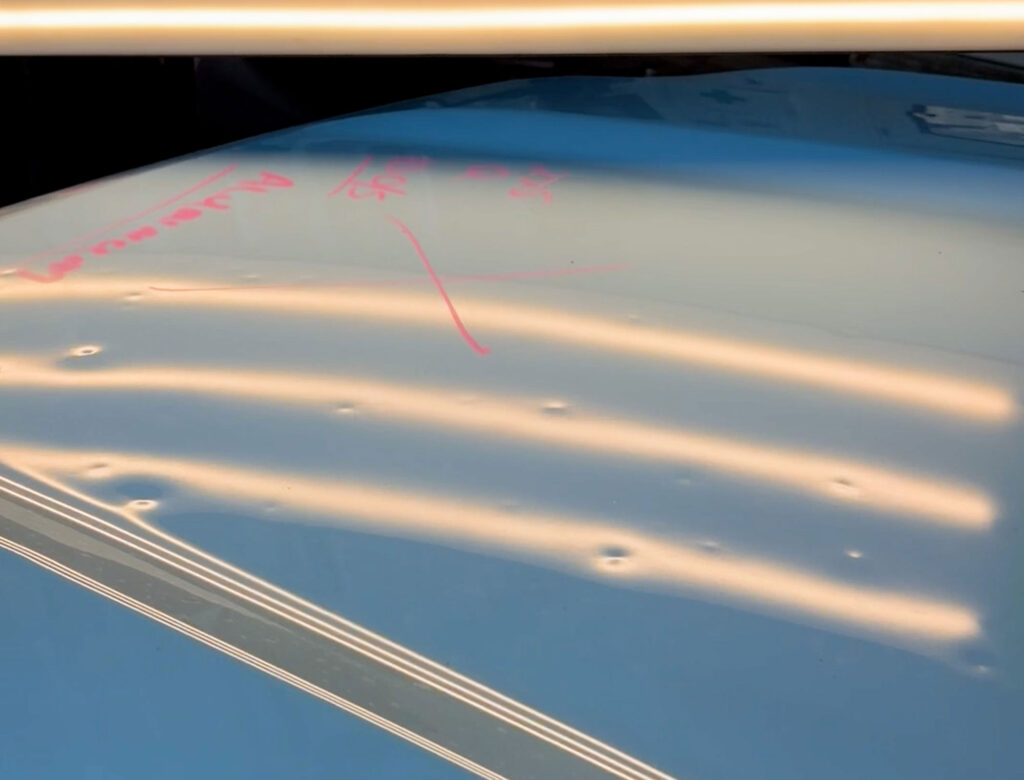
- Look in raking light. Hail damage hides in flat overhead sun. Early morning or late afternoon, at a low angle across the panel, is when it shows.
- Don’t rush. Claims don’t expire the same day, and the first outfit to knock on your door after a storm is rarely the right one.
How Hail Damage Actually Gets Repaired
Almost all of it comes out with paintless dent repair.
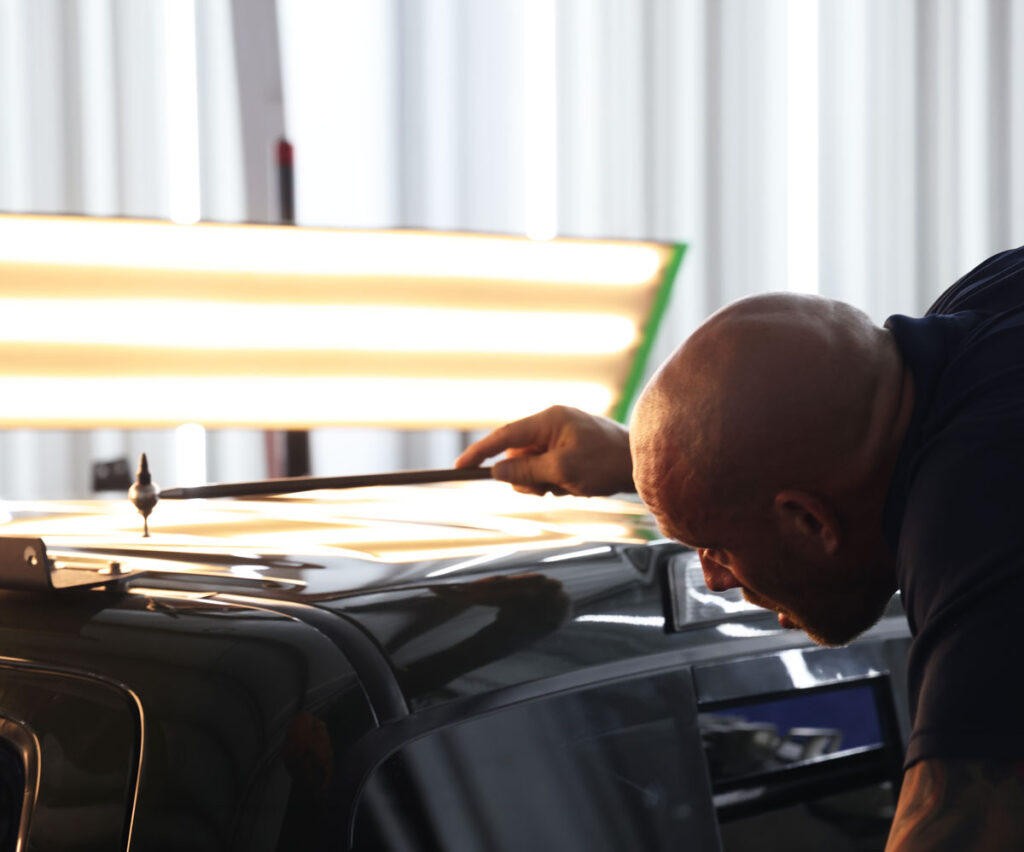
The method is what it sounds like: we reach behind the panel and work the metal back to its original shape with specialised steel rods, reading the surface under LED boards that throw straight shadow lines across it. Wherever those lines bend, there’s still a dent. No filler, no sanding, no spray booth.
The reason that matters isn’t just cost. Your factory paint was baked on at the plant under conditions no body shop can reproduce. Refinish a panel and you’ve got a colour that ages at a different rate than everything around it, plus bodywork to disclose when you sell. Paintless repair doesn’t cover the damage — it removes it, and the finish that comes back is the one the car was built with.
It’s also why insurers prefer it. Faster, cleaner, cheaper for them, and it holds up.
See how we handle hail damage repair →
When Hail Damage Needs More Than PDR
Paintless repair has a limit, and we’d rather tell you where it is than pretend it doesn’t exist.
The method depends on the paint flexing with the metal underneath. If hail has genuinely cracked or chipped the clear coat — which starts around the two-inch mark, sooner with wind behind it — the finish can’t flex and the panel needs refinishing. Same if a stone has punched through or a panel has to be replaced.
That’s where Collision Craftsman comes in: our sister shop, same address, same building. Most jobs that need both get handled without you dropping the car twice.
Filing a Hail Claim in Texas
Hail is a no-fault claim. It falls under comprehensive coverage. You didn’t cause the weather, and carriers generally don’t raise premiums over it.
You choose the shop. Texas law gives you that right. Your insurer can suggest a network; you can decline it.
Get a real inspection before you accept a number. Estimates written off a photo routinely miss panels. We’ll go over the car properly and handle the supplement with the adjuster if the first figure doesn’t cover the work.
Get help with your hail claim →
Hail Damage FAQs
Storm damage on your car?
Send us a photo and we’ll tell you what we’re looking at — no appointment, no obligation. We’ve been repairing Houston hail damage from the same shop since 2000.
📍 Visit the shop: 1729 Brittmoore Road, Unit G, Houston, TX 77043
📞 Call us: (281) 660-3178
Need a Paintless Dent Repair Quote?
Just send us pictures of your damage and we’ll get you a personalized quick estimate!