
What Happens If a Car Dent Is Too Deep for PDR?
Why the “dent shop around me” may not the right dent shop for you… here’s how to know:
Paintless Dent Repair (PDR) feels a bit like a magic trick when you see it in action. One hour your vehicle has an unsightly door ding from a runaway grocery cart, and the next hour the metal is completely smooth with your factory paint still perfectly intact. For most minor dents, dings, and hail damage, PDR is the fastest, most cost-effective, and least invasive repair method available.
But what happens when a dent crosses the line from a simple ding to something much more severe?
At American Dent Specialists, a frequent question we hear on our service drive at 1729 Brittmoore Road is whether a deep dent is past the point of no return for paintless methods. The short answer is that yes, a dent can be too deep for PDR. However, the way we handle that limitation is what sets us apart. We believe you should never have to guess about the cost or viability of your auto body repair.
Our team measures the depth and severity of your vehicle’s damage right on our service drive, giving you an honest, accurate assessment before you spend a single dollar. If the dent has exceeded the physical limits of PDR, we do not turn you away. We transition your vehicle directly to our full conventional collision services to restore it to factory-perfect condition.
To help you understand exactly how these decisions are made, let us dive into the science of metal repair and what happens when a dent goes too deep.
Understanding the Physical Limits of Paintless Dent Repair
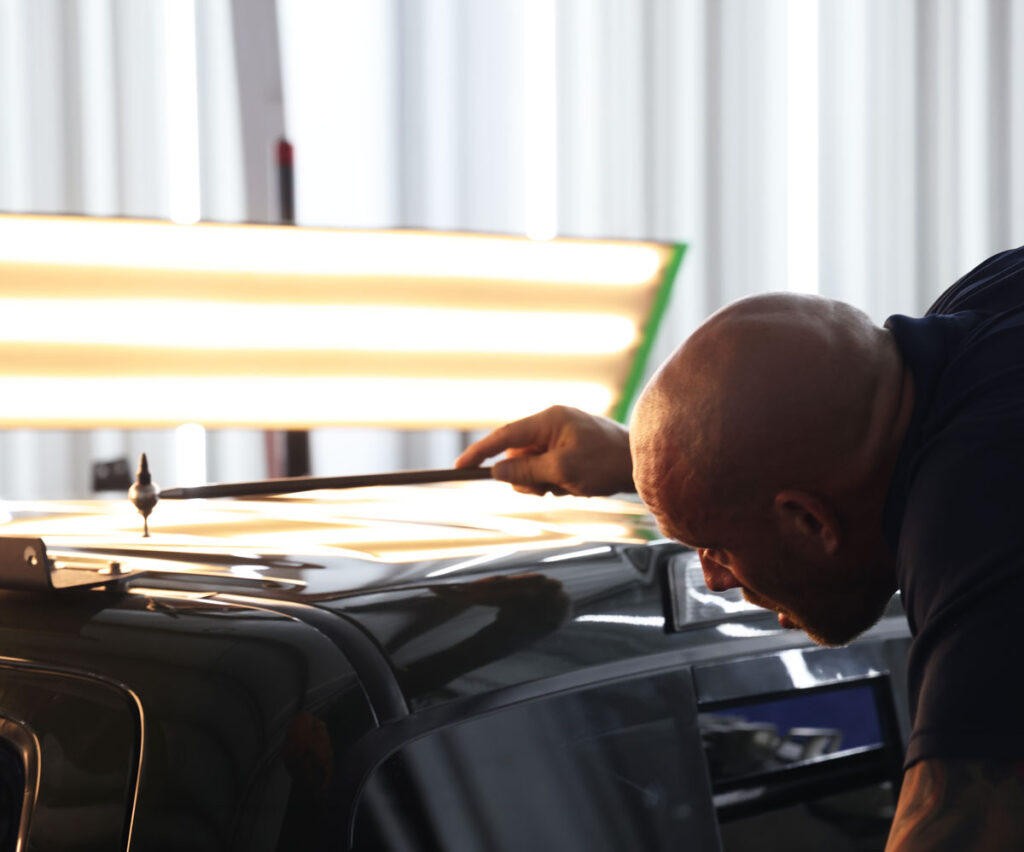
To understand why a dent might be too deep for PDR, you have to look at the metallurgy of your vehicle. Modern automotive sheet metal is designed to be lightweight yet structural. It possesses a characteristic called elastic memory. When a mild impact occurs, the metal bends out of shape, but it wants to return to its original form. PDR technicians use specialized tools to gently massage the metal from behind, reading the light reflection on the panel to guide the metal back into place without disturbing the paint.
However, metal only has so much elasticity. When an impacting object strikes a vehicle with extreme force, it pushes the metal past its elastic limit and enters the zone of plastic deformation. At this stage, the metal is permanently stretched.
The Role of Depth, Sharpness, and Metal Stretching
When assessing a dent, depth is a major factor, but sharpness is arguably even more critical. A wide, shallow dent that covers an entire door panel might look catastrophic to a vehicle owner, but it is often an excellent candidate for PDR because the metal has not been severely stretched in any single concentrated area.
Conversely, a small, incredibly sharp, deep puncture, such as a dent caused by a golf ball or a sharp trailer hitch, presents a much bigger challenge. In a sharp, deep dent, the metal at the very center of the impact point is stretched incredibly thin. If a PDR technician attempts to push that center point back up, there is excess material with nowhere to go. This creates an unstable condition known in the industry as oil canning, where the metal panel loses its structural tension and pops back and forth loosely under the slightest pressure.
Paint Integrity and Creases
Another hard limit for PDR is the condition of the automotive paint. Paintless dent repair relies on the factory paint being flexible enough to move with the metal during the massage process.
If the impact was severe enough to crack, chip, scratch, or crease the paint down to the primer or bare metal, standard PDR is automatically disqualified as a standalone repair. Leaving cracked paint exposed invites moisture, which quickly leads to rust and corrosion beneath the surface. Furthermore, if a dent features a razor-sharp crease where the metal has folded completely over on itself, the paint at the apex of that crease is often already compromised or under such high tension that it will split open during the repair process.
The American Dent Specialists Service Drive Assessment
We do not believe in making customers play guessing games with their vehicles. If you are driving around Houston wondering whether your vehicle needs a traditional body shop or a quick PDR fix, you can get a definitive answer instantly.
The “Before You Spend a Dollar” Policy
When you pull up to our shop off the Sam Houston Tollway, our evaluation process begins immediately. We measure the damage right on our service drive before any paperwork is signed or any money changes hands. This transparent approach ensures that you have a clear, accurate roadmap for your vehicle’s repair before making a financial commitment.
Tools of the Evaluation Trade
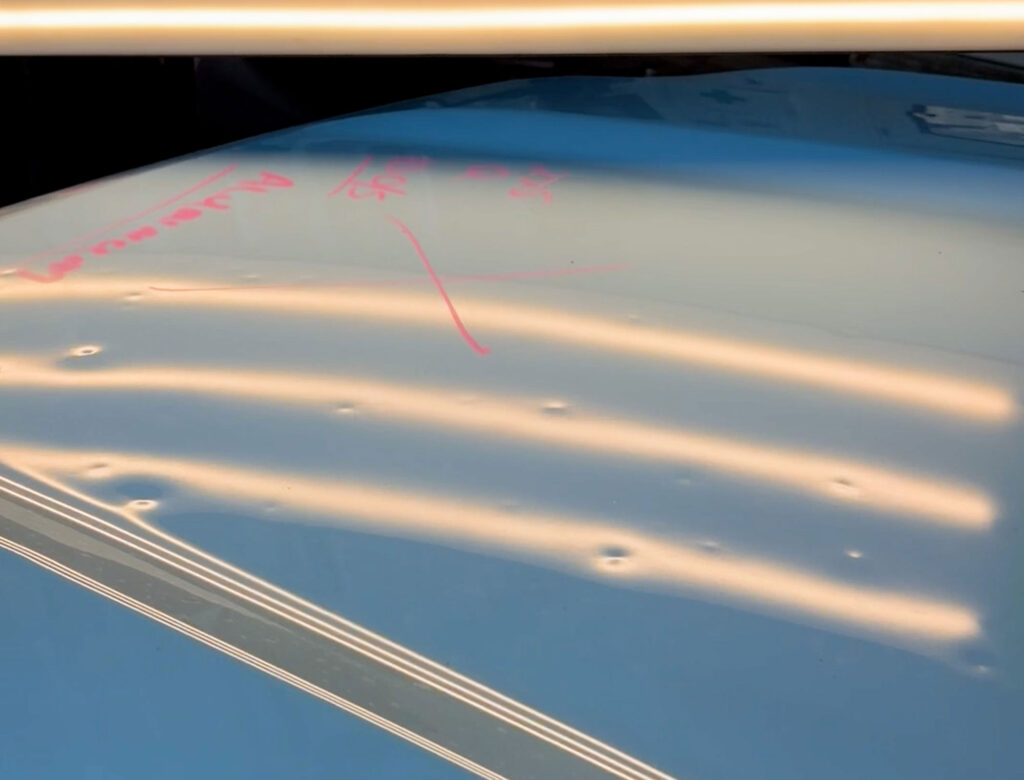
Our technicians do not just eyeball the damage. We use specialized PDR line boards and LED reflection lights to map the topography of the dent. These lights project perfectly straight parallel lines onto the vehicle’s paint.
- Straight lines indicate a perfectly flat, factory panel.
- Wavy or distorted lines show exactly where the metal is bent.
- Lines that pinch tightly together reveal the high-stress areas and deep center points where the metal has been stretched.
By analyzing how these lines behave, we can calculate the exact depth and strain on the metal, allowing us to tell you with mathematical certainty whether PDR will deliver a flawless result or if conventional repair is required.
PDR vs. Conventional Collision Repair
When a dent crosses the threshold and is deemed too deep for paintless methods, the vehicle must transition to conventional auto body repair. Understanding the differences between these two methodologies helps clarify why certain deep dents require extra time and materials.
|
Paint Condition |
Paintless Dent Repair (PDR) |
Conventional Body Repair |
|---|---|---|
|
Metal State |
Must be completely intact with no cracking |
Can repair cracked, scraped, or missing paint |
|
Turnaround Time |
Flexed within elastic limits, no severe stretching |
Stretched, torn, creased, or structurally weakened |
|
Primary Process |
Specialized massage tools applied from behind the panel |
Stud welding, panel pulling, body filler, priming, painting |
|
Timeframe |
Usually completed same-day or next-day |
Multiple days to allow for bodywork and paint curing |
|
Cost Profile |
Highly cost-effective, preserves original factory paint |
Higher cost due to specialized materials, labor, and paint mixing |
When Conventional Methods Take Over
Conventional collision repair is an art form designed to reconstruct panels that have suffered structural deformation. When our service drive assessment determines a dent is too deep for PDR, the conventional workflow takes over:
Paint Removal: The technician sands down the impacted area to expose the bare metal.
Metal Pulling: Using specialized equipment like stud welders, temporary pins are attached to the low points of the dent so a slide hammer or mechanical puller can bring the sub-structure back to its original alignment.
Contouring with Body Filler: A high-quality premium body filler is applied in thin layers and meticulously sanded down to match the exact, original contour of the vehicle body line.
Priming and Sealing: The panel is primed and sealed to protect the repaired metal from atmospheric moisture.
Computerized Paint Matching: Using your vehicle’s exact factory paint code and an advanced spectrophotometer, our paint team mixes a flawless color match to account for any natural weathering.
Refinishing: The panel is sprayed with base coat and clear coat inside a controlled downdraft paint booth, then baked to ensure a factory-quality cure.
Why Local Expertise Matters for Complex Auto Body Work
Houston is a massive, fast-moving city, and driving here comes with unique risks. Whether you are commuting through the Energy Corridor, navigating construction traffic near Spring Branch, or dealing with sudden Gulf Coast hail storms, your vehicle takes a beating.
For 25 years, American Dent Specialists has operated with a deep commitment to the Houston community. Choosing a local shop that houses both elite PDR master technicians and a full-scale conventional collision repair facility provides a distinct advantage to vehicle owners.
Navigating Houston Insurance Claims
Many drivers are hesitant to address deep dents because they dread dealing with insurance companies. Because we provide clear, upfront measurements right on our service drive, we can fast-track the documentation required by insurance adjusters. If a dent is clearly too deep for PDR, we supply the digital line-board metrics and repair justifications directly to the insurer, preventing delays and ensuring your claim is approved for the correct repair method from day one.
The Value of an Integrated Shop
Many standalone PDR operations or mobile dent pullers will look at a deep dent, realize they cannot fix it perfectly, and simply walk away or refer you elsewhere. On the flip side, many massive corporate collision franchises will automatically write up an expensive estimate to replace your entire door panel and repaint half the car, even if the dent could have been safely massaged out with PDR.
Because American Dent Specialists manages both sub-brands under the Collision Craftsman family, we have no bias toward one method over the other. Our only goal is the highest quality, most cost-effective repair for your specific situation. If a dent can be safely fixed with PDR, we will do it. If it is too deep, our conventional team steps in seamlessly.
In fact, we frequently utilize a hybrid approach known as push to paint. If a dent is incredibly deep but the panel structure can be saved, our PDR team will use their specialized tools to rough out the dent and restore 90% of the metal shape without using heavy body fillers. Then, our conventional team takes over to finish the fine sanding, priming, and painting. This results in a structurally superior, long-lasting repair that uses a fraction of the body filler required by traditional shops.
Signs Your Dent Might Require Conventional Repair
While we always recommend letting a professional measure the damage on our service drive, you can look for several clear indicators on your own vehicle to see if a dent is heading down the conventional repair path:
- The paint inside the crater is compromised: If you can see spiderweb cracks, flakes, exposed grey primer, or raw metal, PDR alone will not suffice.
- The dent sits on a rigid body line: Car designers build sharp body creases into doors and fenders to give the sheet metal structural rigidity. If an impact collapses one of these hard styling lines completely flat, the metal is severely stretched and usually requires conventional mechanical pulling.
- The dent is located on a double-walled panel edge: The outer edges of hoods, trunks, and door skins are hemmed and bonded to interior structural braces. If a deep dent occurs directly over these heavily reinforced, double-walled locations, access from behind is completely blocked, making standard PDR tool access impossible.
- The metal feels completely loose: If you lightly press near the center of the dent and the metal makes a loud clicking sound or flops back and forth effortlessly, the panel has lost its structural tension from extreme stretching and must be repaired conventionally.
Frequently Asked Questions About Deep Dent Repairs
Get an Accurate Measurement Today
Stop staring at that dent and guessing how much it will cost to fix. Drive your vehicle over to American Dent Specialists at 1729 Brittmoore Road, Unit G, and let our team take a look. We will measure the damage right on the service drive, walk you through the physics of the repair, and provide a clear, upfront estimate before you spend a single dollar. Whether your vehicle is a perfect candidate for rapid PDR or requires the meticulous care of our full conventional collision shop, we have you covered.
📍 Visit the shop: 1729 Brittmoore Road, Unit G, Houston, TX 77043
📞 Call us: (281) 660-3178
📅 Schedule: americandentspecialists.com
Need a Paintless Dent Repair Quote?
Just send us pictures of your damage and we’ll get you a personalized quick estimate!